
Are Cover Letters Required in 2026? A Decision Tree by Application Type
The honest answer is by application type, not yes-or-no. A decision tree across six cases: large-company portal, recruiter-mediated, referral, startup direct-to-founder, government and regulated industries, and internal transfer.
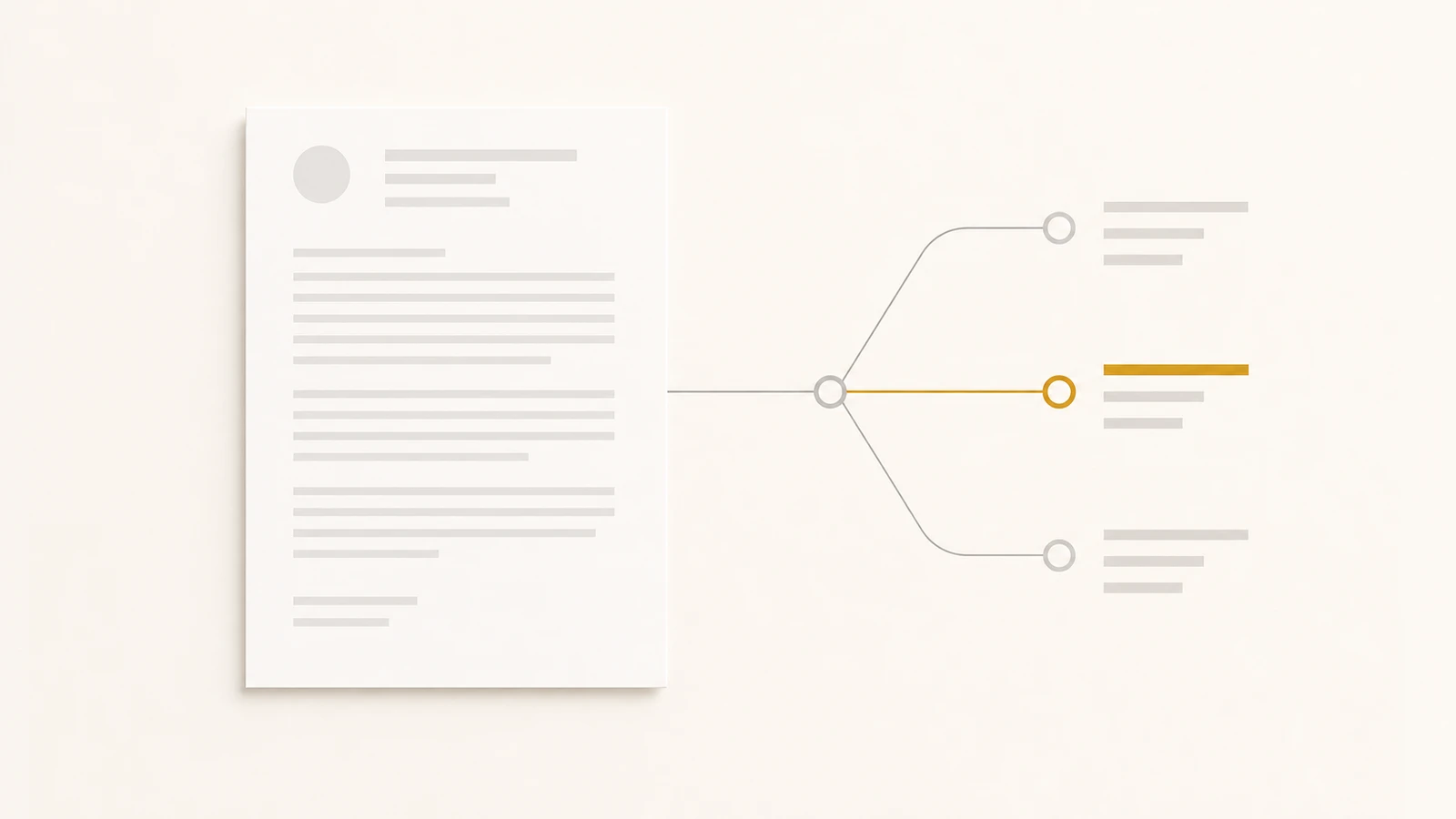
Most articles answer "are cover letters required?" with a clean yes or no. The honest answer depends on what kind of application you're sending. A cover letter does different work in a 5,000-employee company's online portal than in an email to a founder. It does almost no work when a recruiter is already advocating for you, and it does most of the work in a cold application where there is no recruiter in the loop.
Six common application types produce four different verdicts: required, recommended, optional, or skip. Applying the wrong verdict in either direction (writing a 300-word cover letter to a hiring manager who didn't want one, or skipping the letter when you needed it) costs interviews. The reasoning behind each verdict matters more than the verdict itself, so the cases below explain what the cover letter is doing, or failing to do, in each path.
For the underlying question of whether cover letters still matter at all in 2026, see How to write a cover letter that gets interviews; the answer is yes, with conditions. This post is the conditions, mapped to the actual ways people apply for jobs.
Six cases, six verdicts
1. Large-company online portal: Recommended
Verdict: Recommended. The portal makes the field optional, but the screening pass and most hiring managers read what is there. A specific cover letter on a borderline file is the nudge from "maybe" to "phone screen."
At a 1,000+ person company, a posted role typically gets 200 to 1,000 applications in the first week. The recruiter parses the queue against the keyword screen, opens the resumes that pass, and rejects most of those in under a minute each. A cover letter at this stage does not save a weak resume. It does help a candidate who is competent-looking but not obviously a top-five fit get a closer read.
The letter has to be specific. Paragraph two needs to name something concrete the company published in the last 90 days. The writing has to read as a human's, not as a ChatGPT draft with the company name swapped in. Generic cover letters at large companies are slightly worse than no cover letter; they cost the recruiter time and signal a candidate who applied without thinking.
When to skip even at large companies: if the role is highly transactional (entry-level support, warehouse operations, a short-term contract) and the recruiter explicitly says cover letters are not reviewed, take them at their word.
A practical note: large-company portals often hide the cover letter field as "additional information" or "candidate notes." If there is no upload field, the text area at the bottom is where the letter goes. The hiring manager will read it.
2. Recruiter-mediated application: Optional, often skip
Verdict: Optional, leaning toward skip. A recruiter actively advocating for you is doing a better version of the work a cover letter would do. Don't make them compete with your own document.
The recruiter, whether agency or in-house, has spent time understanding the role and your background and will brief the hiring manager directly. Your resume plus a five-minute conversation with the recruiter give the hiring manager more context than your cover letter would. Sending a separate cover letter at this stage often duplicates the recruiter's note in a worse form.
Three exceptions where a cover letter is still worth sending through the recruiter:
- You want to preempt a specific concern. A career gap, a location question, an unusual career trajectory. A short note explaining the situation gives the recruiter ammunition to address it before the hiring manager raises it.
- The recruiter explicitly asks for one. Some agencies require a cover letter as part of their submission package. If asked, send one and tailor it.
- You have a strong specific reason for this company. A short cover letter naming the reason gives the recruiter something to lean on with the hiring manager beyond the generic "this candidate is qualified."
For most recruiter-mediated applications outside these cases, skip the cover letter. Spend the time on a 30-minute prep call with the recruiter instead; that conversation is the cover letter, in a more useful form.
3. Referral-based application: Depends on the referrer
Verdict: Depends on the strength of the referral. A strong internal vouch makes a cover letter mostly redundant; a weak introduction does not.
Three referral strengths that matter:
Strong: a current employee actively advocating. Someone on the team or in the function who knows your work, will message the hiring manager directly, and will name specific reasons you'd be good. This is the most valuable hiring signal in the modern job market, and a separate cover letter adds little. Skip the formal letter; send a short thank-you to the referrer with a few details they can paste into their note (one project of yours that maps to the role, your availability, the specific role title). The referrer's words land harder than yours can.
Medium: an introduction. A current employee passes your resume along with a brief endorsement but is not going to lobby for you internally. A short cover letter helps here because the introduction got you read but did not argue for you. Same three-paragraph structure as a cold application, with the referrer named in paragraph one to inherit some of their credibility.
Weak: a name-drop. Someone you barely know agreed to be mentioned, or you found a mutual connection on LinkedIn. The "referral" is mostly nominal. Treat the application as cold and write a full cover letter; mentioning the connection in paragraph one is fine but it is doing very little work.
A useful test: would the referrer write a one-paragraph endorsement of you to the hiring manager unprompted? If yes, your cover letter is redundant. If no, your cover letter is the endorsement, and it has to be good.
4. Startup direct-to-founder application: Required
Verdict: Required, in a different format. At a startup, the cold email to the founder or hiring manager is the cover letter. There is no separate cover-letter document; the email body carries the full weight.
Most early-stage startups either don't have an applicant tracking system or have one nobody monitors. Roles are posted on the careers page, on the founder's X feed, and on a few aggregators, and the actual hiring decision happens when an email lands in the founder's inbox. A candidate who submits the form on the careers page and nothing else is competing with candidates who emailed the founder directly with a tight three-paragraph pitch attached to their resume PDF.
The format is the same as a formal cover letter, with two adjustments:
- The email body is the letter. No "see attached cover letter." The first thing the founder reads is your subject line and your first paragraph.
- The subject line carries weight. Specific is good ("Senior backend engineer applying for the payments role you posted Tuesday"). Cute is bad ("Excited about [Company]!"). Use the subject the founder would use in their own email.
What the email needs: the role you're applying for in paragraph one with one credibility claim, paragraph two with one specific reason for this company in the last 90 days, paragraph three with one concrete next step. The same content as a formal cover letter, plain-text in an email, with your resume attached as a PDF.
5. Government and regulated industries: Required
Verdict: Required. Federal jobs, defense contractors, healthcare regulators, banks under specific regulatory frameworks, and most state-level public-sector roles either require a cover letter or treat its absence as a procedural flag.
The reasoning is structural, not stylistic. Government and regulated-industry hiring follows formal processes that include a cover letter as part of the candidate file, often with specific format requirements (a cover memo, a statement of interest, a personal statement). HR audits the file before it reaches the hiring committee. A missing cover letter creates an incomplete application and the candidate is removed before the qualifications round.
A few specifics by sub-category:
- Federal jobs (USAJOBS in the US, equivalents in other countries). Formal cover letter required; the system often labels the field "cover letter" or "statement of interest." It typically runs to one page, with specific accomplishments mapped to the position description.
- State and local government. Less standardized but still expects a cover letter for any professional role. Format varies by jurisdiction.
- Defense contractors and cleared positions. Cover letter required and read carefully because clearance suitability is part of the assessment.
- Healthcare and regulated finance. Variable: large hospital systems and big banks treat the cover letter as part of HR's audit trail; smaller regulated firms may not require one but still expect it for senior roles.
The shape of the letter differs from a private-sector letter. Less voice, more direct mapping of qualifications to the position description. Specific phrases from the job posting should appear, literally, in the cover letter. The reader is not deciding whether you're interesting; the reader is checking whether you meet a specified bar.
6. Internal transfer: Required, different shape
Verdict: Required, but it is a different document. An internal transfer cover letter (sometimes called an internal memo, a transfer note, or an internal application statement) is required at most companies and expected almost everywhere, even when a hiring manager doesn't formally ask for one.
The misconception is that an internal candidate doesn't need a cover letter because their work record is already internal data. The work record tells the receiving team what the candidate has done; it doesn't explain why they want this team or what they bring that isn't visible from their existing role. Without that explanation, the receiving manager has to guess at motivation, which is the most common reason internal candidates lose to external candidates for the same role.
The shape is shorter and more direct than an external letter:
- Half a page, two paragraphs. Brevity is expected; the receiving manager already has access to your performance reviews.
- Paragraph one: why this team, why now. A specific reason rooted in something the team is doing that you have a perspective on. Generic interest in the function ("I want to grow my product skills") loses to specific interest in the work ("Your team's pricing experimentation framework is the project I want to work on for the next two years").
- Paragraph two: what you bring that isn't in the HRIS. Cross-team collaborations the receiving manager wouldn't know about, side projects, mentorship of someone they've worked with, a perspective from your current function that the new team would benefit from.
Skip the formal three-paragraph external structure. Keep the "why this, why now, what I bring" frame and write it as a candid memo to a colleague who happens to be a hiring manager.
The pattern across the six
Reading the six verdicts together, the pattern is straightforward. The cover letter does work proportional to the gap between you and the hiring manager. When the gap is large (cold application to a stranger, a portal at a company where nobody knows you), the cover letter is doing most of the persuasion. When the gap is small (a recruiter who already pitched you, a teammate transferring to an adjacent group), the cover letter is mostly redundant and sometimes unhelpful.
The four verdicts, plainly:
- Required: the application format expects it, or the application is the cover letter. Cold founder outreach, government roles, internal transfers.
- Recommended: the format makes it optional but a strong letter materially improves your chances. Large-company portals.
- Optional, often skip: a human in the loop is already advocating. Recruiter-mediated applications.
- Depends: the strength of an existing connection determines the value. Referral-based applications.
A useful test for any case not on the list above: is there a person in the loop who can advocate for you better than your letter could? If yes, the letter is redundant. If no, the letter is doing the work of persuasion and probably belongs in the application.
Where to read next
For the underlying question of how to write a cover letter that earns interviews when one is required, see How to write a cover letter that gets interviews. The three-paragraph structure works for every case in this post, with the adjustments described above.
For the resume side of the application (which is required across every case), see How to write a resume in 2026.
For what specific applicant tracking systems weight when they parse your file, see the ATS resume guide.
A ProPage page builds your resume and cover letter on a single data model. Update the most recent role once and both refresh. Export the cover letter as a clean PDF for a portal that requires one, share the URL when an application is more conversation than form.