
How to Write a Resume in 2026: The Complete Guide
A step-by-step guide to writing a resume that reads well, passes ATS filters, and reflects who you actually are in 2026.
A resume in 2026 has two readers.
The first is an Applicant Tracking System, software that parses your document against a job description and decides whether a human ever sees it. The second is that human, usually a recruiter, who will spend about six seconds on page one before deciding to read further or move on. Most resumes fail at least one of these readers. A good resume passes both without contorting to please either.
This guide walks you through that resume. Not a template you fill out. Not a list of buzzwords. The decisions a recruiter or an experienced peer would make with you if they sat down for an hour, in the order you need to make them.
The two readers every 2026 resume has to pass
Before you write anything, understand who is actually reading.
The ATS comes first. It is a parser that reads your PDF, pulls out structured fields — name, email, role titles, employer names, dates, education, skills — and compares those fields to the job description. Greenhouse, Workday, Lever, iCIMS, SmartRecruiters, Ashby, Taleo. They differ in interface and scoring logic, but they all ingest the same thing: plain text pulled out of your file. Anything the parser can't read reliably becomes noise. Anything the parser can read becomes a keyword match or a missing match.
The human reader comes second. A recruiter's eye travels in a predictable path on page one: name and title at the top, most recent role under it, a quick check on length of tenure, a drop to the bullets underneath the most recent role. If what they see in the first six seconds looks like a fit (the right job titles, the right seniority, the right industry), they'll read further. If it doesn't, the resume goes into the "no" pile. That six-second number has been replicated in eye-tracking studies since 2012 and updated upward slightly in 2018; the rough shape of the behavior is well-established, even if the exact count drifts.
These two readers want different things and the same thing. The ATS wants structured, machine-readable content. The recruiter wants a document they can skim. Both of them are served by clear structure, literal language, and content in the places content belongs. Both of them are harmed by clever layouts, icon-as-heading tricks, and three-column designs that look sharp in Figma and come out shredded in the parser.
A resume that works for both is not a compromise. It's the same document, made well.
What changed between 2019 and 2026
Most resume advice you'll find online was written before 2020. Some of it still applies. Some of it doesn't. Here's what actually shifted.
AI-assisted screening got common. ATS used to be a dumb keyword matcher. By 2024, large employers were routing resumes through an LLM pass before the human saw them: summarizing, scoring, and sometimes drafting the initial recruiter note. The practical effect is that a resume now needs to survive a second layer of machine reading that understands context, not only keywords. Generic language gets discounted. Specific, verifiable claims do better. A bullet that says "collaborated cross-functionally" is worth less to a 2026 LLM reviewer than a bullet that says "paired with the payments team to ship idempotency keys for our refund API." The first one is words. The second is evidence.
Applications are link-first. Five years ago, recruiters Googled you after the initial review. Now they click the links on your resume during the first review. If your resume has a GitHub that redirects to a broken page, a portfolio that 404s, or a LinkedIn headline that contradicts the title on your resume, the resume is done before your bullets are read. The links on your resume are part of your resume.
Remote normalized, and then partially un-normalized. Between 2020 and 2023, location became invisible on most resumes. Since 2024, location has partially returned: hybrid roles require it, senior roles often want it, and VC-backed startups increasingly advertise "in-office in SF or NYC" and screen on that. List a city. You don't need the street.
The document itself is less important than it used to be. This is the deepest shift. A resume used to be the primary artifact an employer saw; LinkedIn was a weaker, redundant copy. In 2026, for most knowledge workers, the primary artifact is a URL the employer clicks. The PDF is a specific export of a richer thing, a page that may also have examples, contact info, a list of writing and talks, and the same resume rendered as a web layout. That shift doesn't make the resume itself less important. It changes how you produce it. More on this below.
Pick one format and stop worrying about it
There are three resume formats and you should use one of them. Most people overthink this.
Reverse chronological. The default. Most recent experience first, older experience below. Works for every knowledge-work career path. If you've had a coherent, forward-moving career, this is your resume. Recruiters expect it; ATS parse it reliably; nothing is served by an alternative.
Functional (skills-based). You group accomplishments by skill rather than by job. It's the format career coaches sometimes recommend for career-changers or people hiding employment gaps. Recruiters know this and treat functional resumes with suspicion. A functional resume signals "this person is hiding something" even when the candidate isn't. Avoid it. If you have a gap, be honest about the gap in the cover letter and keep the resume chronological.
Hybrid (combination). A short skills section at the top over a chronological experience section underneath. Defensible in exactly one case: a deep career change where your recent job title genuinely obscures the role you're applying for. A marketing analyst moving into product management, a lawyer moving into ops, a teacher moving into an engineering bootcamp and then into a junior engineering role. Outside that case, the skills section at the top is pure filler and the hybrid is a chronological resume with a worse opening.
Unless you're changing careers deeply, use reverse chronological. The format is solved. Put your energy into what goes inside it.
The four zones every resume needs on page one
Every resume has the same four zones on page one in the same order. Think of them as fixed slots.
Zone 1: the header. Your name in a larger size. Your current role or the role you're targeting as a subtitle, something like "Senior Software Engineer" or "Product Manager, Payments." Your city, email, phone, and one professional URL. Nothing else. No address. No date of birth. No photograph in most Western countries; photographs are standard in continental Europe and some parts of Asia, and the norm differs by region. Default to no photograph unless the local hiring convention requires one.
Zone 2: the summary. Three sentences. We'll rewrite this section below.
Zone 3: experience. Your most recent job first, listed with company name, role title, location (or "Remote"), and dates. Bullets underneath, ideally three to five per role, each starting with an action verb and ending with a measurable outcome.
Zone 4: the rest. Education, skills, projects, awards, volunteer work. The order inside zone 4 depends on what you're applying for. A new graduate puts education high. A senior IC pushes education to the bottom and leads with experience. A consultant or contractor sometimes leads with a selected-clients or selected-projects block.
That's the page. Every resume that works follows this shape. The variation is in the content, not the layout.
The summary: three sentences, not a manifesto
Your summary is three sentences at the top of the page. It answers one question: what are you, for whom, at what seniority? Not a career objective. Not a mission statement. Not a paragraph of adjectives. Three sentences.
The structure that works:
Sentence one. What you are, in one line the recruiter could repeat to their boss. Example: "Senior backend engineer, eight years in Go and Python, focused on payments infrastructure at mid-sized B2B SaaS."
Sentence two. A credential, outcome, or specific claim. Something concrete the reader could verify. Example: "At Stripe from 2021 to 2024, I led the migration of the refund pipeline from synchronous to event-driven, reducing p95 latency from 2.1s to 180ms."
Sentence three. What you're looking for next, framed as what you want to do rather than what you want to be given. Example: "Looking for an IC or staff role where infrastructure reliability is the business, not the substrate."
Three sentences. Seventy words. Every word earns its place.
What the summary is not: "Results-driven professional with a passion for innovation." No hiring manager has ever been moved by that sentence. Strip any phrase from your summary that could appear on someone else's resume unchanged. If what's left is specific to you, you have a summary. If what's left is generic, you have filler, and filler in the top third of a resume is expensive real estate.
Bullets that survive six-second scanning
The bullets under each role are where your resume is either made or wasted. Most are wasted.
Every bullet starts with an action verb. Built, shipped, led, designed, migrated, reduced, grew, negotiated, hired, closed, scaled. Not "responsible for." Not "helped with." Not "was involved in." An action verb says you did the thing. The passive phrases say you were in the room when the thing happened. The recruiter is trying to figure out what you did, not who you were around.
Every bullet ends with a measurable outcome. A number, a percentage, a before-and-after, a scale, a compounding effect. The verb says what action you took; the outcome says why it mattered. "Rewrote the billing service" is half a bullet. "Rewrote the billing service, cutting invoice generation latency from 8 seconds to 400 milliseconds for 2M customer accounts" is a bullet.
The middle of the bullet is the specifics. What you worked on, who you worked with, what constraint you had to hold. This is where a bullet stops being generic and starts being yours. "Launched three campaigns" applies to half of marketing. "Launched three campaigns targeting enterprise IT buyers, using ABM plays to generate $2.4M in pipeline over six months" is someone's real work.
Numbers beat adjectives, always. "Large-scale systems" is weaker than "systems serving 12M DAUs." "High-performing team" is weaker than "a team of 14 ICs." When you don't have a number, use a scope instead: the size of the team, the size of the budget, the name of the customer, the duration of the project. "Partnered with Procter & Gamble on a six-month pricing redesign" says more than "Partnered with a major consumer goods brand."
Cut the bullets that don't earn their line. Three to five strong bullets per role beat eight mediocre ones. A recruiter who reads five strong bullets trusts the rest of the resume. A recruiter who reads eight bullets including two weak ones starts discounting everything else. Weak bullets cost you more than they give.
Here's the shape, with a before-and-after:
- Weak: Responsible for managing a team of engineers and working on backend systems.
- Strong: Led a team of six backend engineers through a 14-month replatform from a monolithic Rails app to a Go-based service architecture, cutting deploy time from 45 minutes to under three and supporting a 4x growth in MAUs without a reliability incident.
The weak version contains one claim (managed engineers) and nothing to verify. The strong version contains six verifiable claims: team size, duration, source platform, target platform, deploy-time delta, MAU growth. A recruiter can read that bullet and form a question they'd ask in an interview. That's what a bullet is for.
One more pair, from the business side:
- Weak: Helped grow the sales pipeline by working on marketing campaigns.
- Strong: Built and launched three outbound email sequences targeting enterprise CIOs, generating 412 qualified meetings and $4.1M in closed revenue over nine months, the highest-converting program in the company's history.
Same pattern. The weak version could sit on anyone's resume. The strong version belongs to one person doing one job during one specific period, and every claim is checkable. When a bullet can be ported wholesale onto a stranger's resume without changing a word, it isn't your bullet. It's filler wearing your name.
Skills, education, and the sections most resumes get wrong
Zone 4 (everything after experience) is where resumes accumulate clutter. Audit it ruthlessly.
Skills. Include a skills section only if the role is skill-gated. Software engineering roles want to see a compact list of languages, frameworks, and infrastructure, three lines at most. Data and ML roles want the stack. Design roles want the tools. For generalist roles (marketing, operations, project management, most business-side work), the skills section is filler at best and padding at worst. The skills you claim without evidence in the bullets above are either already visible in the experience section or not worth claiming.
If you do include a skills section, group by category, not by proficiency level. "Expert in Excel, Intermediate in SQL" is a tell. "Languages: Go, Python, TypeScript. Infrastructure: AWS, Terraform, Kubernetes" is how a technical reader reads quickly.
Education. Put education at the top if you graduated in the last two years and you're applying for a role where the degree is the primary credential. Otherwise, education goes at the bottom, two to three lines per degree: institution, degree, graduation year. GPA appears only if it's above 3.7 and you graduated in the last five years. Coursework appears only if it's directly relevant and you're a new graduate. High school does not appear after you have a bachelor's degree. Ever.
Projects. Worth including if you're junior and your experience section is thin, or if you're a senior IC whose side work is public and relevant. Two or three projects, each with a one-line description and a link. A GitHub repo without a README is not a project.
Certifications. List them only if they're genuinely required or genuinely distinguishing. AWS Solutions Architect Professional is worth listing if you're targeting cloud infrastructure roles. A free Coursera certificate on "Python for Everybody" is not. The test: would the recruiter pass you over if it weren't on your resume? If no, cut it.
Awards and publications. List them if they're named and recent. "Forbes 30 Under 30, 2023" is a signal. "Employee of the Month, 2018" is a line you'd rather not have.
Interests and hobbies. Almost never. The exception is a hobby that's verifiable, unusual, and connects to the work: a competitive powerlifter applying to a strength-training company, a ham radio operator applying to a telecom. Otherwise cut. "I enjoy hiking and reading" is what you say when you haven't decided what the resume is about.
Gaps, transitions, and how to be honest without apologizing
Most people have something on their resume they'd rather not have to explain. An eighteen-month gap after a layoff. A six-month stint at a company that didn't work out. A career pivot where the new role doesn't connect cleanly to the old one. Parental leave. A sabbatical. A health situation. The instinct is to hide it: stretch dates, drop the short role, paper over with vague language. The instinct is wrong, and in 2026 the cost of acting on it has gone up.
Hiring managers have seen every form of obfuscation, and LLM-assisted screening now flags date inconsistencies between a resume and LinkedIn automatically. If you list a job as "2022 – 2024" on your resume and "May 2022 – January 2024" on LinkedIn, the difference is visible within seconds of a recruiter clicking your profile. You haven't hidden the gap. You've added a credibility problem on top of it.
The alternative is short, specific honesty.
For a gap under three months, do nothing. Three months between jobs is within the range of a normal job search and nobody will ask about it.
For a gap of three to twelve months, add a one-line entry on your resume between the adjacent roles. "2023 – 2024: Career break" or "2023: Parental leave" or "2023 – 2024: Extended travel and independent study." No apology, no explanation, no justification. The line exists to close the timeline, not to persuade anyone. Save the context for the cover letter or the recruiter call, where you have time to frame it.
For a gap over twelve months, the same one-line treatment, and if you did anything useful during the gap (contracting, open-source work, caregiving, a serious skill-building project), add a second line under the gap entry describing it in the same dry style as any other role. "Contracted for two SaaS companies on authentication rewrites" is a defensible line. "Discovered myself as a person and a father" is not.
For a short stint you'd rather leave off, don't. A role of six months or longer belongs on your resume. Omitting it creates a gap the parser will notice and a recruiter will ask about, and the answer you'll have to give ("I left that role off because it didn't work out") is worse than listing the role would have been. If the role is less than six months and ended badly, you have some discretion. Contractors commonly omit sub-three-month engagements, and the convention is accepted.
For a career change, the resume has to help the reader see the bridge. If you're moving from a lawyer's role into a product operations role, your most recent legal bullets should emphasize the operational, process-design, cross-functional work that maps onto the new function. Same bullets, same facts, different selection and different verbs. The bullets you'd write for a law-firm partner role and the bullets you'd write for a head-of-operations role are different subsets of the same underlying job.
For a layoff, say "layoff" or don't say anything. A 2023 layoff from a public tech company carries no stigma; hiring managers know what happened. The exception is back-to-back layoffs within a year, which will read as a pattern even if it's bad luck. In that case, a cover letter that names the pattern and the context does the work the resume can't.
The deeper principle: the resume does not have to be a highlight reel. It does have to be accurate and legible. A resume that dates itself honestly and has one calm line explaining a gap reads as mature. A resume that fudges dates and hopes nobody notices reads as unreliable. The first gets interviews; the second doesn't, even when the candidate is objectively stronger.
Build once, render everywhere
Here is the problem the old resume workflow has, stated bluntly: you maintain a Word document. You export it to PDF when you need to apply. You copy parts of it into LinkedIn, knowing the formatting won't match. You copy other parts into your personal site, knowing you'll forget to update it. A recruiter Googles you, lands on your LinkedIn, sees a 2022 job title, and decides you aren't looking, or isn't sure what's current.
The root cause isn't lack of discipline. It's that the resume, the LinkedIn profile, and the personal site are three separate documents pretending to be one. Every update has to happen three times, and any two of them drift within a month.
The 2026 fix is one source of truth, rendered multiple ways.
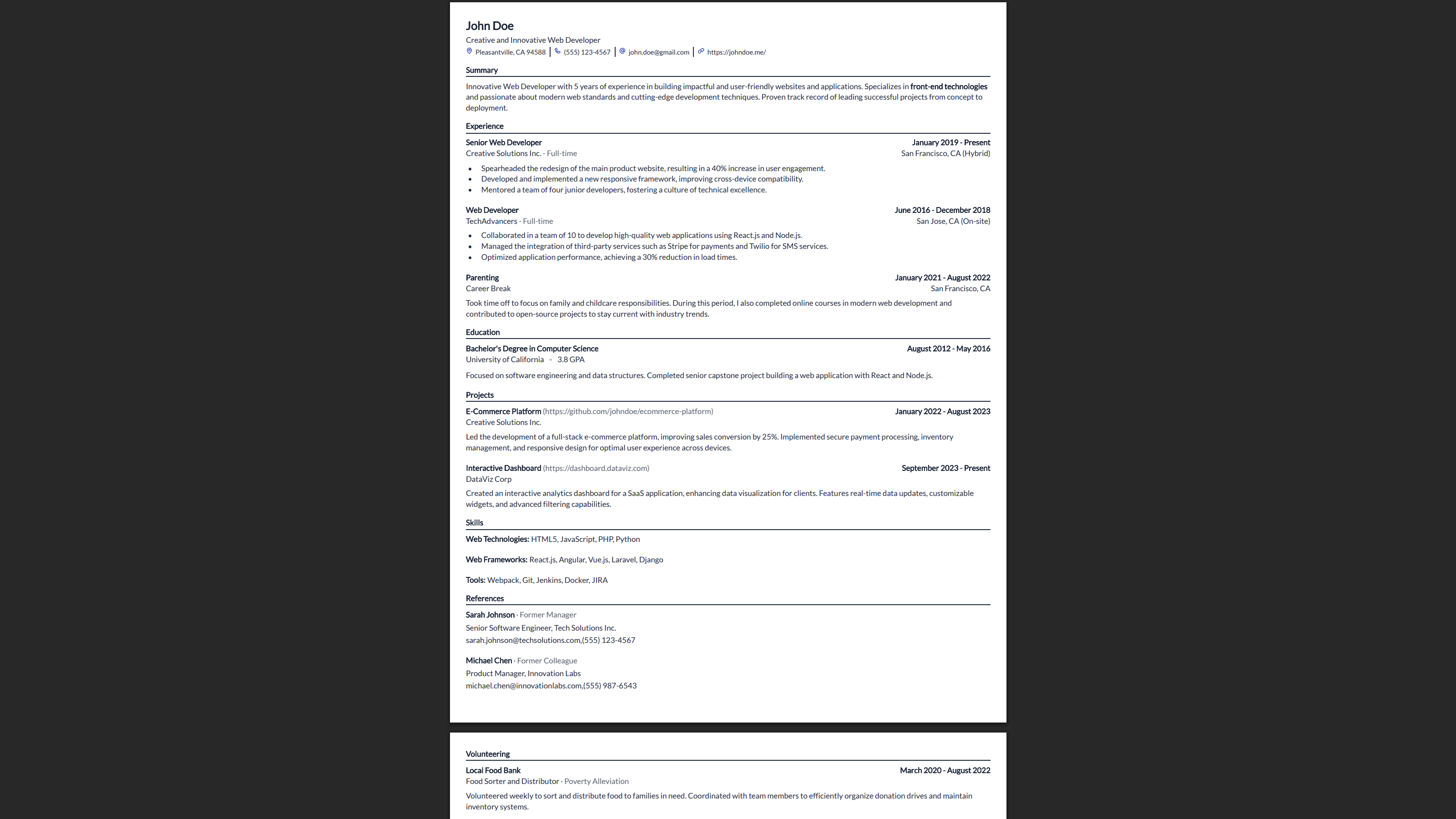
One document, one data model, two outputs. The paper rendering is the PDF you upload to a job portal: single-column, machine-readable, optimized for the parser. The web rendering is the page that lives at your URL: styled, readable on a phone, the thing a recruiter sees when they click your URL from your resume. The content is identical because it's the same content. Update your most recent role once and both renderings refresh.
This is what ProPage does. The resume isn't the artifact; the URL is. The resume is an export.
That shift has downstream consequences you feel the moment you adopt it. You stop maintaining three versions of your career story. You stop having to decide whether to keep your LinkedIn one job ahead of your resume or one job behind. When a recruiter Googles you, the top result is your page: not Reddit, not a dormant Medium post, not an X account you abandoned in 2019. The URL does the work a business card used to do: the compact, portable introduction to who you are professionally, pointed at by every channel you'd share.
The final pass: tailoring, formatting, and what to cut
You have a draft. Now tailor it for the specific role you're applying for and run it through the final checklist.
Tailor the top third. This is the single highest-leverage edit on a resume and the one most people skip. Open the job description next to your resume. The nouns and verbs that appear three or more times in the JD are the keywords that matter. Your summary and your first three bullets under your most recent role should use those words, literally: not synonyms, not paraphrases. The ATS is looking for a literal match; the recruiter is looking for the language they already know describes the role. Mirror the JD and both readers nod.
Do not keyword-stuff. Do not drop a block of skills at the bottom of the resume to pad the count. The penalty for keyword stuffing from modern LLM-augmented screening is higher than the penalty for missing a keyword; a resume that reads like a job description badly paraphrased back at itself gets flagged. Mirror the language where it's natural. Leave the rest alone.
Check the formatting.
- Single column. No side-by-side sections on page one.
- Fonts a recruiter recognizes. Arial, Calibri, Helvetica, Inter, Source Sans, Times New Roman. Nothing you had to download.
- Font size 10 to 11 for body, 14 to 18 for your name. Smaller than 10 is hostile to the reader; larger than 18 for your name looks insecure.
- Standard section headings. "Experience," "Education," "Skills." Not "My Journey." Not "What Drives Me."
- No images, no icons as headings, no colored sidebars, no progress bars rating your skills 4 out of 5. Every one of those looks sharp in a portfolio shot and comes out mangled in the parser.
- Export to PDF from a word processor or a resume builder. Never export from a design tool without selectable text; an image-based PDF is invisible to the ATS.
Check the length. One page for the first ten years of your career. Two pages when you genuinely have a decade of directly relevant work and cutting to one page would force you to omit roles a reader needs to see. Never three pages. If your resume is three pages, you have not decided what matters yet; go back and cut.
Check the links. Click every URL on your resume. Your email must be one you actually check. Your LinkedIn must render. Your GitHub, if listed, must not 404. Your professional page, if you have one, must display your current role. A dead URL on a resume is a self-inflicted wound.
Check the dates. Month-year format, consistent across every role. "Jan 2021 – Present." Gaps longer than three months either get explained in the cover letter or don't appear. An honest "2022 – 2023: Career break" beats a fudged date every time.
Read it aloud. A bullet you stumble over when reading aloud is a bullet you haven't finished writing. Rewrite it. A summary that feels stiff when you speak it feels stiffer on the page.
Cut ten percent. After the draft is done, delete ten percent. Not the weakest bullet in each section. Ten percent of the whole document. Almost every resume has a page of content trapped inside a page and a half of filler. The tighter version always lands better than the sprawl.
Write the resume. Put it at a URL that belongs to you. Update it once, not three times.
When you're done with the resume itself, the other half of the application (the cover letter) is worth reading about: How to write a cover letter that gets interviews. If you want to go deeper on the parser side of this, ATS resume: how to beat applicant tracking systems gets into the specific platforms and what each one parses well.
For the broader argument that the URL, not the document, is the thing you're actually building, see What is a professional identity URL.
Future chapters in this guide will go deep on the summary, bullet construction, and role-specific versions: resume summary examples, 200+ resume action verbs, and the software engineer resume guide.