
200+ Resume Action Verbs, Sorted by What They Claim
200+ resume action verbs in ten categories: build, ship, lead, measure, design, hire, sell, scale, decide, and repair. One rule per category. 30+ example bullets showing the verbs open real work.
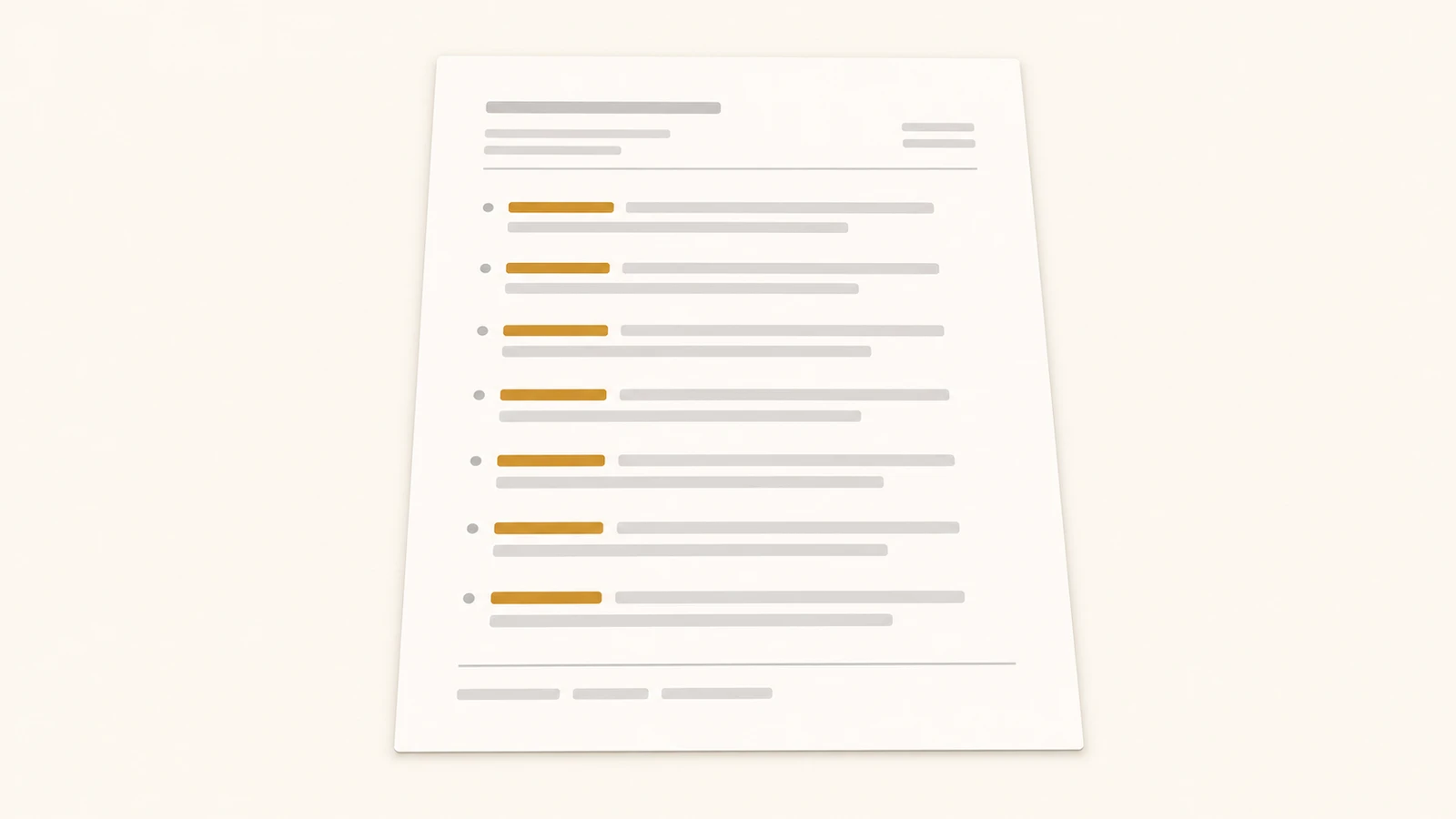
The first word of every resume bullet is the most-read word on the resume. A recruiter doing a six-second scan reads the verb, the noun next to it, and a number at the end of the line; everything between gets sampled, not read. That puts the verb in a load-bearing position. If it carries the wrong claim, the rest of the bullet has to fight uphill for the next half second of attention.
Standard resume advice is to swap weak verbs for stronger ones: replace "responsible for" with "managed," "helped with" with "led." That swap is correct and not enough. A list of 200 stronger verbs is the wrong tool for the job when it gets used as a thesaurus. The right tool is a list categorized by what kind of claim the verb actually makes. "Built" is a claim about creation. "Shipped" is a claim about release. "Led" is a claim about people. They are not interchangeable, and a recruiter or an LLM-augmented screening pass reads through the mismatch in under two seconds.
Two hundred verbs, sorted into ten categories that cover almost every line of knowledge work: build, ship, lead, measure, design, hire, sell, scale, decide, repair. Every verb appears in exactly one category, so two lists never sell the same word in different costume. Thirty-plus include a one-line example bullet showing the verb opening real work, the kind that ends in a number.
Use the list as a structuring tool, not a refill. If your bullet doesn't have a strong verb, the next question to ask is what kind of work it actually describes. Then pick from the matching category.
A verb is a claim, not a synonym
Most action-verb lists are organized alphabetically or by stretched themes like "leadership verbs" or "results verbs." Those groupings push you toward the most flattering verb that fits any bullet, which is how résumés end up with five lines opening "spearheaded" for work the writer mostly attended.
The frame that holds is the claim. Every action verb makes a specific claim about what kind of work you did:
- A build verb claims you created something that didn't exist before.
- A ship verb claims you released something to people outside your immediate team.
- A lead verb claims you owned an initiative or a group of people.
- A measure verb claims you analyzed and quantified something.
- A design verb claims you specified how something looks or works.
- A hire verb claims you brought in or developed people.
- A sell verb claims you closed an external agreement.
- A scale verb claims you grew an outcome by a multiple.
- A decide verb claims you set direction.
- A repair verb claims you fixed something that was broken.
Most knowledge work falls inside those ten claims. The few cases that don't (research, regulation, art) usually borrow from build, design, or measure. If you can't place your bullet's verb into one of these categories, the bullet probably hasn't decided yet what work it's describing.
The lists below have no overlap. "Architected" is a design claim, not a build claim. "Migrated" is a ship claim, not a repair claim. The restriction is what makes the verb you pick name the work cleanly.
Ten categories of work
Build
The rule. Use a build verb when the artifact didn't exist before you started. The claim is heavy: not "I worked on X," but "X is here because I made it." Reach for these on first-of-its-kind work: a new system, a new doc, a new function. If you contributed to something that already existed, a build verb overstates the work and gets penalized by LLM-augmented screens.
The list. Built, Created, Authored, Founded, Engineered, Constructed, Developed, Established, Wrote, Coded, Programmed, Drafted, Composed, Crafted, Forged, Bootstrapped, Pioneered, Originated, Implemented, Assembled, Spun up, Stood up, Instituted, Formed.
In use.
- Built a Stripe-to-NetSuite reconciliation pipeline that closed three days of finance lag for a $40M ARR business.
- Authored a 60-page onboarding handbook used by 14 incoming PMs over the next two years.
- Founded the company's first internal platform engineering guild, which now sets standards for 80 engineers.
- Wrote the SQL style guide that ended a six-month argument about how to format CTEs.
Ship
The rule. Use a ship verb when the work crossed an internal boundary into the world: customers, partners, the open-source community, regulators. Building and shipping are different claims; building stops at the artifact, shipping is about who got it and when. A bullet that says "shipped" should always have a date or a count of recipients in the same line.
The list. Shipped, Launched, Released, Deployed, Delivered, Published, Announced, Rolled out, Pushed, Premiered, Debuted, Unveiled, Cut over, Introduced, Activated, Distributed, Demoed, Open-sourced, Productized, Migrated.
In use.
- Shipped a self-serve cancellation flow that cut churn-related support tickets from 600 to 90 per week.
- Launched the partner API to 200 invited customers, generating $1.2M in attached revenue in the first quarter.
- Migrated the analytics warehouse from Redshift to Snowflake over four months with no downtime windows.
- Open-sourced the internal feature-flag library, now used in production at four other companies.
Lead
The rule. Use a lead verb when the work involved a group of humans choosing to follow you. The claim is that the outcome wouldn't have happened without your direction, not that you were on the team. A lead verb followed by a number of people is the strong shape: "Led 14 ICs through..." reads as real; "Led an effort to..." often reads as a stretch.
The list. Led, Directed, Spearheaded, Headed, Ran, Owned, Championed, Steered, Guided, Coordinated, Managed, Oversaw, Anchored, Chaired, Convened, Marshaled, Mobilized, Stewarded, Captained, Helmed.
In use.
- Led a six-engineer pod through a 14-month replatform from Rails to Go, ending with a 4x deploy frequency.
- Owned the migration of every customer-facing form across 12 product surfaces to a single design-system component.
- Chaired the cross-functional incident review board that brought sev-1 frequency from 2.4 to 0.6 per quarter.
- Spearheaded the accessibility audit that brought 78 checkout flows to WCAG 2.2 AA before the regulatory deadline.
Measure
The rule. Use a measure verb when the unit of work is data: collected, analyzed, modeled, presented. The claim is that you reduced uncertainty for the people who acted on what you found. A measure bullet without a number in it is missing its second half.
The list. Measured, Analyzed, Quantified, Tracked, Audited, Assessed, Benchmarked, Evaluated, Modeled, Forecasted, Projected, Calculated, Profiled, Investigated, Examined, Surveyed, Charted, Computed, Gauged, Reported, Inspected, Reconciled, Tested, Validated.
In use.
- Quantified onboarding drop-off stage by stage and identified that 41% of churn was concentrated in two screens.
- Forecasted twelve-month server costs for a usage-based pricing change, sized within 4% of actual.
- Audited 230 enterprise contracts to surface a $1.8M-per-year clause-language gap nobody had been billing for.
- Benchmarked our p99 read latency against the four closest competitors and shipped the dashboard to the C-suite quarterly.
Design
The rule. Use a design verb when the work was specifying how something looks, behaves, or fits together, not actually constructing it. Architects design buildings; carpenters build them. The same verb split applies to systems, processes, and product surfaces. If the artifact you produced was a spec, a wireframe, a diagram, or a system model that someone else then built, a design verb is the honest one.
The list. Designed, Architected, Conceived, Conceptualized, Sketched, Wireframed, Prototyped, Illustrated, Storyboarded, Visualized, Specified, Diagrammed, Blueprinted, Outlined, Templated, Themed, Styled, Branded, Rebranded, Patterned.
In use.
- Designed the loyalty tier structure that became the spine of every retention experiment for the next three years.
- Architected the multi-region failover plan that survived a full us-east-1 outage with 11 seconds of customer-visible disruption.
- Wireframed every screen of the mobile redesign across 32 user flows ahead of engineering kickoff.
- Templated the renewal email sequence so every account manager could ship a tailored version in under 20 minutes.
Hire
The rule. Use a hire verb when the unit of work was a person: bringing them in, growing them, or keeping them. The category is narrow on purpose. Mentoring an intern is hire-shaped; running a project that happened to include junior engineers is lead-shaped. The verb names what you did to or for the person specifically.
The list. Hired, Recruited, Mentored, Coached, Trained, Onboarded, Retained, Promoted, Sourced, Interviewed, Vetted, Sponsored, Apprenticed, Tutored, Upskilled, Reskilled, Inducted, Cultivated, Counseled, Taught.
In use.
- Hired and onboarded eight engineers in nine months without a regrettable departure in the next two years.
- Mentored three junior PMs through to senior promotion in 18-month cycles, two of whom now lead pods.
- Recruited a director of design out of a Series-D competitor by closing the offer in 11 days.
- Trained the entire 22-person CS team on the new admin tooling, replacing a four-week ramp with a two-day workshop.
Sell
The rule. Use a sell verb when money or a binding agreement changed hands because of what you did. Internal alignment is not selling; persuading a colleague is not selling. The counterparty has to be external (a customer, a partner, an investor, a vendor) and the outcome has to be a deal that was signed, renewed, or expanded. Be precise about the deal size or the counterparty, or the verb sounds inflated.
The list. Sold, Closed, Negotiated, Persuaded, Pitched, Won, Secured, Booked, Signed, Renegotiated, Renewed, Upsold, Cross-sold, Prospected, Qualified, Converted, Landed, Procured, Brokered, Convinced.
In use.
- Closed a $2.4M three-year enterprise deal with the largest pediatric hospital network in the Midwest.
- Negotiated a 38% reduction in cloud spend by consolidating four AWS accounts and renegotiating the EDP.
- Won a competitive RFP against three incumbents to become the default ATS for a 14,000-person retailer.
- Pitched the Series A to 28 firms over six weeks and signed term sheets with three of them.
Scale
The rule. Use a scale verb when the unit of work is multiplication: more usage, more revenue, more throughput, more reach. The claim is comparative; a scale bullet without a starting and ending number is a claim without a measure. "Grew the team" without saying from what to what is filler. "Grew the team from four to eleven in two quarters" is a fact.
The list. Scaled, Grew, Expanded, Tripled, Doubled, Quadrupled, Increased, Boosted, Accelerated, Compounded, Amplified, Extended, Broadened, Globalized, Internationalized, Localized, Replicated, Standardized.
In use.
- Tripled qualified pipeline year over year by rebuilding outbound sequencing around named-account research.
- Localized the product into nine languages and grew non-US revenue from 7% to 31% of ARR in 18 months.
- Compounded weekly active organizations from 1.2k to 9.6k over 14 months without raising paid-acquisition spend.
Decide
The rule. Use a decide verb when the work was choosing direction for an organization larger than yourself. Deciding what to do next on your own task is not a decide verb; setting the company's pricing, killing a product line, picking a vendor for a hundred-person team is. The strongest decide bullets name what was chosen, what was rejected, and what changed afterward.
The list. Decided, Prioritized, Set, Selected, Chose, Determined, Resolved, Approved, Authorized, Sanctioned, Ratified, Endorsed, Vetoed, Killed, Sunsetted, Deprecated, Discontinued, Pivoted, Reorganized, Repositioned.
In use.
- Sunsetted three legacy SKUs that accounted for 4% of revenue and 28% of support load.
- Deprecated the v1 API on a 12-month timeline, communicating the deadline to 1,200 integrators with a 96% migration rate.
- Pivoted the team away from a six-month roadmap when usage data showed the planned feature wouldn't move retention.
Repair
The rule. Use a repair verb when the artifact already existed and your work made it healthier: faster, cheaper, less broken, less complex. Repair verbs pair almost universally with a delta: a percentage cut, a latency drop, a number of bugs closed, a cost reduction. The before and after are the bullet's spine.
The list. Fixed, Repaired, Patched, Debugged, Refactored, Rewrote, Hardened, Stabilized, Recovered, Restored, Salvaged, Rejuvenated, Tuned, Optimized, Reduced, Cut, Eliminated, Minimized, Trimmed, Mitigated, Remediated, Diagnosed, Triaged, Untangled, Modernized, Upgraded.
In use.
- Reduced p95 checkout latency from 2.1s to 180ms by rewriting the synchronous tax-lookup path as event-driven.
- Triaged a Friday-night production incident affecting 11 enterprise tenants and restored service inside 23 minutes.
- Cut monthly cloud spend by $84k by right-sizing 240 over-provisioned database instances.
- Modernized a Rails 4 codebase to Rails 7 over five months while continuing to ship weekly customer features.
When two verbs both fit, pick the smaller one
Most resume disagreements about verb choice are between two adjacent categories. You designed a system AND built it. You led the team AND shipped the product. You decided the direction AND scaled the result. The instinct is to pick the verb that sounds biggest. The instinct is wrong.
The reason is the LLM-augmented screening pass that runs between the keyword match and the human reviewer. It evaluates whether the verb's claim is supported by the rest of the bullet. "Spearheaded" over four facts that read as "I implemented this on a team of three" gets discounted, sometimes hard. The penalty for an inflated verb is now larger than for one slightly small for the work.
The rule that holds: when two verbs fit, pick the smaller claim. "Built" beats "Architected" if you wrote the code. "Implemented" beats "Pioneered" if a colleague proposed the approach. "Coordinated" beats "Spearheaded" if other people had the same authority. The reader can always upgrade the verb in their head if the bullet supports more; they cannot downgrade an inflated one without flagging the bullet.
A strong verb does not save a weak bullet
The hardest thing to internalize about action verbs: they are necessary, and not sufficient. A bullet that opens with "Spearheaded" and continues with "cross-functional initiatives delivering high-impact outcomes" is not stronger than one that opens with "Helped on" and continues with "the migration of 4M customer accounts to a new billing engine over six weeks." The verb is bigger; the bullet is smaller. A 2026 screening pass reads through the verb to the work behind it, and so does any recruiter who has been hiring for more than a year.
Three things separate a strong bullet from a long one.
A verb that names the actual work. Pick from the matching category, prefer the smaller claim, and never use "responsible for" or "helped with."
A specific noun in the middle. Not "systems," but "billing engine." Not "campaigns," but "outbound email sequences targeting enterprise CIOs." The noun is what makes the bullet yours and not the next applicant's.
A measurable outcome at the end. A number, a percentage, a duration, a scope, a named counterparty. Without the outcome, the verb and noun together are a job description, not a bullet.
If a bullet is thin, the fix is rarely the verb. The fix is usually the second or third part: a number that wasn't there, a noun that was too generic, a scope that was implied instead of named. Once those land, the verb gets to do its job.
One further habit worth installing: update your resume in the same place your public page lives. When the verb you reach for changes, the page and the document update together, and the version a recruiter sees on your URL matches the version they read in the PDF you uploaded. The cross-check that recruiters now do in the first 30 seconds becomes a confirmation, not a contradiction.
Where to read next
For the full guide that this chapter belongs to, see How to write a resume in 2026. The "Bullets that survive six-second scanning" section is the one this article goes deeper on.
If your verbs are landing but the second half of your bullet is still soft, the ATS resume guide walks through what specific systems weight and what they don't.
When the resume is done, the cover letter is where most candidates lose the next step. How to write a cover letter that gets interviews carries the same one-page-three-paragraph discipline this list applies to verbs.
For the broader argument that the URL is the artifact and the resume is an export of it, see What is a professional identity URL.
A ProPage page renders your resume as both an ATS-safe PDF and a public URL from one source of truth, so a verb you change once shows up everywhere a recruiter might check.