
What Is a Professional Identity URL? (And Why You Need One)
Your professional identity is scattered across containers you don't control. A professional identity URL is the address it lives at instead, and the change is in who controls it.
Open a new tab. Search your own name.
What comes up? A LinkedIn profile, probably first. A GitHub page if you write code. An X account you forgot the password to. An old Medium post you would rewrite if you reread it now. A company website with a paragraph of bio that someone in HR copy-edited five years ago. A dated personal site you have meant to update since the year you started it.
That collection is your professional identity, as the internet currently knows it: fragments in containers you do not control, rendered in formats you did not design, found in an order Google decides. Anyone who searches for you is reading you in that order, drawing conclusions in that order, deciding whether to email you in that order.
A professional identity URL is the alternative answer to that search. The one you can shape on purpose.
What a professional identity URL actually is
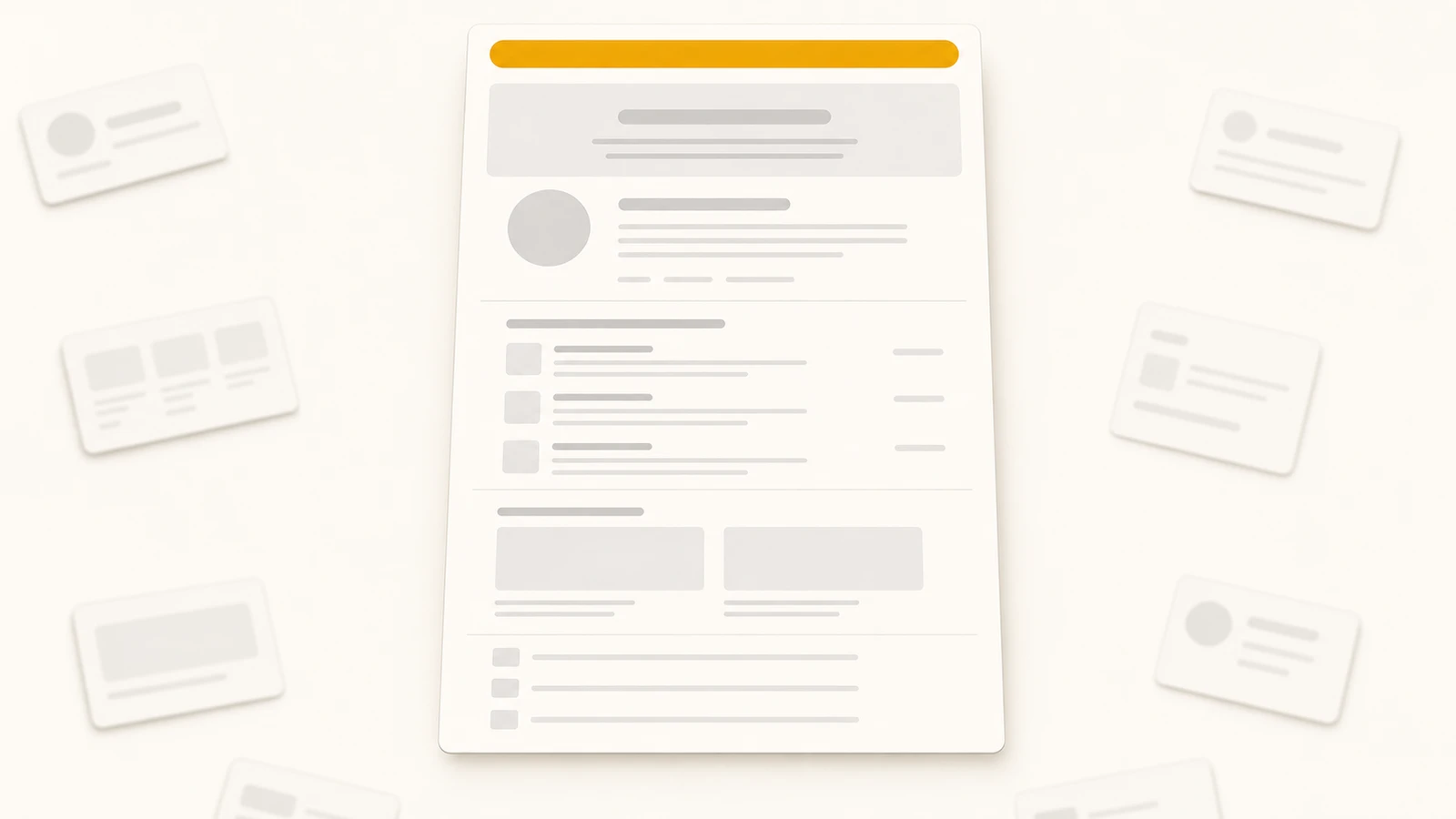
A professional identity URL is one address that contains your professional self online. One source of structured data, your name, your headline, your experience, your education, your work, your contact, rendered into the format whoever is looking needs. A recruiter who needs an ATS-safe document gets one. A hiring manager who clicks the link from your email signature gets a clean web page. Google indexes the same page as a real result when a potential client looks you up. Same source, different views, one URL.
The technical shape of it matters less than the social shape. When a colleague introduces you to a buyer, they paste one link. When a recruiter asks for your resume, you give them one link. When a journalist quotes you, they hyperlink one link. Your professional identity has an address, the way your home does, and the address points at the version of you that is current right now, not the version a former employer froze in a PDF in 2023.
Two things are doing the work in that definition.
First, the data is structured. Not paragraphs in a freeform website, not media uploaded to a profile builder. A name field. A title field. An employment history with start dates, end dates, employer names, role descriptions. A skills list. A location. The structure is what allows the same data to render as a single-column ATS-safe PDF when needed and as a styled, mobile-friendly web page when shared. A free-form personal website cannot do this; the content is HTML, not data.
Second, the URL is durable. It does not change when you change jobs. It does not depend on a platform's continued willingness to host you on the same path. It is yours in the sense that an email address is yours, with an underlying identity layer that can be ported if it ever needs to be.
Why this matters now
Three shifts in the last five years made the URL the thing that travels.
Every application is filtered by software first. Greenhouse, Workday, Lever, iCIMS, Ashby, Taleo. The first reader of your resume is a parser, not a person, and the document you submit has to survive that parser before a human looks at the bullets. The need for a parseable document has not gone away; if anything, AI-assisted screening has made it harder, because the post-parser layer reads context, not only keywords.
Hiring managers Google your name on the first read. They click the links on your resume during the first review now, not after the recruiter screen the way they used to. If your resume has a portfolio that 404s, a GitHub that redirects, or a personal site whose H1 contradicts the headline on your resume, the contradiction is in front of them in the same five-second window the resume itself was supposed to fill.
Professional introductions now happen by link. The thing a buyer asks for, the thing a colleague forwards, the thing you put under your name in an email signature, all of it is one URL. Your link is the work the business card used to do, and it has to do that work without the human standing next to it to explain.
One URL answers all three. A scatter of disconnected accounts answers none of them cleanly.
What it is not (and the four things people confuse it with)
A professional identity URL is not the same as the four things it most resembles. The differences matter, because each of those four serves a different audience or a different job. Treating any of them as a substitute is how people end up maintaining four versions of themselves and updating none.
A biolink page (Linktree, Beacons, Bio.link)
A biolink is a list of links optimized for the bottom of an Instagram or TikTok bio. The job is sending followers somewhere they can convert: to a music release, an Etsy store, a Patreon, a digital download. The audience is followers; the metric is click-through. Linktree, in its 2024 Creator Commerce Report, said biolinks across its network draw more than 1B clicks a month, with Instagram the single largest source. That is real volume on real intent. It is also creator volume.
A biolink page does not produce a resume. It does not understand employment dates. It does not export a single-column PDF that an ATS will accept. It is not built for a person whose audience is hiring managers, because a hiring manager is not browsing your bio looking for the next thing to click; they are deciding in five seconds whether you are worth a screen.
If you have followers, use a biolink. If you have a career, that is not the tool.
LinkedIn is the largest professional network in the world. Your LinkedIn profile is rented identity: you do not own the URL, the layout, the visibility, or the placement of your information in the feed. LinkedIn's product decisions are made for the LinkedIn business model, which is selling Recruiter and InMail seats, not for the professional whose face is on the profile.
This is not a complaint about LinkedIn. The network it gives you is real; the connections do real work; the discovery surface is wider than any single URL of yours can match. But a LinkedIn profile is a record on someone else's database, and the moment LinkedIn ships a layout test, deprioritizes a section, or inserts a sponsored block above your headline, your professional identity reflects that decision and not yours.
A professional identity URL is the layer beneath the network. It is what your LinkedIn bio links out to when someone wants to see more than the LinkedIn template will allow. The two are complementary by design. LinkedIn is where you are discovered; your URL is where you are seen properly.
A personal website
A personal website is a free-form container. You buy a domain, pay for hosting, build a site in Squarespace or Framer or Wix or by hand, and now you own a web property. People do this and people enjoy doing it. It is a worthwhile thing to have.
It is also not a professional identity URL, for two reasons. The content is unstructured: paragraphs and images, not fields. There is no resume export, no ATS-safe PDF, no machine-readable employment history. If a recruiter asks for a resume, you go open a separate tool, and the resume that comes out of that tool is one more version of you to maintain alongside the site. And the maintenance burden is high enough that most professionals build a personal site in the first three months of a job change and let it go stale by month six. The dated personal site at the bottom of your search results is, almost certainly, a personal site that was current once.
A professional identity URL has the same data discipline a resume has. You update an experience entry; the page and the PDF both reflect it. The maintenance burden matches the value, instead of exceeding it.
A digital business card
A digital business card is a point-in-time contact-exchange artifact. You hand it over (or NFC-tap it, or text the link) at a conference or a meeting, and the recipient adds your name and email to their address book. Taplink's April 7, 2026 explainer pitched this as a category in its own right, and the category is real: handing someone a paper card and waiting for them to type it into their phone is a worse experience than tapping a URL into a contact form.
The job a business card does is small and specific. Pass over enough information to be reachable later. A professional identity URL can serve that purpose at the moment of exchange (your URL goes onto the digital card you hand over), but it does more than the card can. The card carries your contact info. The URL carries your work.
If you only ever need to be reached, a card is enough. If anyone might want to verify you between meeting you and emailing you, your URL is the address they will end up at.
The URL is the artifact. The document is an export.
This is the shift, and the rest of this guide follows from it.
For most of the last forty years the resume was the artifact. It was the file you sent, the thing your former employers had a copy of, the version of you that traveled into the interview room before you did. Other things existed around it (a cover letter, a portfolio, a website, eventually a LinkedIn), but they orbited a center, and the center was the document. When you updated yourself professionally, you opened the document and edited it.
That ordering was correct when documents traveled and URLs did not. In 2026 it is inverted. The thing that travels is a URL. A recruiter clicks a link in your email signature. A hiring manager pastes your name into Google and reads what comes up. A buyer asks a colleague who you are and gets sent one address. The URL is the artifact your professional identity is delivered through; the document is one of the formats that URL produces when a particular system needs one.
This does not change what you write. It does not change the bullets or the verb choices or the seniority you signal. What it changes is which version of you is the source of truth. When the resume was the artifact, the resume was canonical; the website, the LinkedIn, the cover letter were three downstream copies of it that drifted apart over time. When the URL is the artifact, the URL is canonical; the resume PDF, the cover letter, the LinkedIn bio link are three exports that all start from the same data and refresh together when the data refreshes.
This is the frame the rest of this guide rests on. It is also the frame How to Write a Resume in 2026 keeps coming back to when it talks about building once and rendering everywhere. The resume itself does not get less important. It gets produced differently.
Three composite case studies
What follows are three composite case studies. The roles, the sequences of events, and the outcome shapes are drawn from interviews and observed patterns; the names and specific details are constructed. Treat them as illustrative of how an identity URL changes opportunity flow, not as endorsements from the named individuals.
Case 1: The independent consultant
A management consultant, six years out of MBB and three years independent, working on operational due diligence for mid-market private-equity firms. Call her S.
Before. Her professional surface was four things: a LinkedIn profile saying "Independent Consultant" with bullet points still inherited from her firm years, a Squarespace site she had built when she went independent and updated twice since, a PDF resume she emailed when a partner asked, and a portfolio of slide decks she sent over WeTransfer one engagement at a time. The four did not agree with each other. The LinkedIn headline was generic. The Squarespace site emphasized strategy projects from her firm years and underplayed the diligence work that had become her practice. The resume reflected a third version of her self, written for a corporate-development role she had interviewed for and not taken. The slide decks were the most current artifact she had, but they were buried in private email threads no one outside the engagement could find.
The cost showed up as opportunity friction. A partner at a PE firm she had worked with twice introduced her to the firm's new operating partner, who Googled her and pulled up the Squarespace site. The headline read "Strategy Consultant for Founders," which was true once and was no longer the work she did. The introduction call started with the operating partner asking about the wrong specialty. The follow-on engagement she had been positioned for went to someone else.
After. She moved everything to one URL. The page led with a tight headline ("Operational due diligence for lower-mid-market PE"), a six-line summary, three case studies anonymized to the level her clients had cleared, a methodology note, and a contact form. The resume PDF rendered from the same data, and her LinkedIn profile pointed at the URL.
What changed in the next ninety days. Two PE firms whose portfolio companies overlapped with her past clients found her by name search and cold-emailed her about diligence work. The most senior of them said in the first call that he had searched her name after a partner mentioned her, read the case studies, and decided to call before the partner made the formal introduction. Her LinkedIn DMs from recruiters, which had been routine for years, started arriving with the role specialization correct. The introduction-and-pitch loop she had been losing on shortened by about two weeks per engagement, because the version of her the buyer met online was the version of her she actually was.
The headline number she shared later was that the URL did not generate new top-of-funnel volume. It improved conversion. The same volume of buyers met her online; more of them treated her as the right person to talk to about the right work.
Case 2: The senior engineer
A senior backend engineer, eight years in, currently at a post-IPO consumer company on its infrastructure team. Call him M.
Before. His public surface was the engineer-standard set: a GitHub with a few starred repos and a profile bio he had written in 2019, a personal site he had stood up after his last job change and not touched since, a LinkedIn that listed his current title accurately, and a two-page resume he updated for the recruiter pings he occasionally answered. Recruiters would DM him on LinkedIn, ask for a resume, get the PDF, and either go quiet or schedule a screen on the strength of the title alone.
The pattern that bothered him was the going-quiet half. His current work was a multi-quarter authentication redesign and the migration of the company's payments service from synchronous to event-driven. Both were exactly the projects a hiring manager at a similar-stage company would want to talk to him about. His resume listed both as bullets. The bullets read like every other senior backend engineer's bullets, because the resume format only had room for verbs and outcomes, not for the parts of the work that made it interesting.
The thing his resume could not do, and which a URL could, was carry depth.
After. He built a page with the resume embedded, a section called "Systems I have shipped" that linked to short anonymized writeups of three projects (the authentication redesign, the payments migration, and a search-relevance experiment from his previous role), a feed pulling his last few months of public commits, and a small "currently thinking about" block that was three paragraphs on idempotency keys. He updated the resume to include the URL on the contact line. He left the LinkedIn alone except to add the URL there too.
The recruiter loop changed. The volume of inbound DMs did not change much. What changed was conversion from DM to first round. Recruiters had a place to send hiring managers between the DM and the screen, and hiring managers who actually read the page came into the screen with informed questions about systems he had built. Two of the three offers he ended up considering came out of conversations where the hiring manager opened the call by referencing a sentence on the page.
The number he gave was three first-round screens in two weeks against a baseline of one in the previous two months. The volume of outbound contact had not changed. The version of him the recruiter could pass forward had.
Case 3: The mid-career career-changer
A senior technical product marketer, six years at a B2B SaaS company, laid off in a restructuring and now applying for first-time product-management roles. Call her P.
Before. Her search-and-apply loop was disciplined. Resume tailored per application. Cover letter rewritten per application. LinkedIn refreshed to the current week. The personal site she had built in 2021 in WordPress kept up at least to the level of having a current photograph and a working About page. The site's H1 read "Marketing Strategist."
What was happening in the funnel: she applied to roughly eighty PM and APM roles in two months. Four hiring-manager conversations resulted. Two callbacks beyond those. No offers. The pattern she could see and did not yet know how to fix was that her resume said one thing and her web presence said another. The resume had been rewritten to position her marketing work as PM-adjacent: positioning experiments, customer-discovery interviews, roadmap input, prioritization work she had owned as a senior IC. The web presence said marketer in plain text on the homepage, on the about page, in the H1, and in the site's meta description that Google had cached.
A hiring manager who searched her name saw the marketer story before they read the resume. The application got rejected before the resume was the document being judged. She had been trying to fix the resume. The thing that needed fixing was the contradiction between the resume and the page Google indexed for her.
After. She took the WordPress site offline and stood up one URL with one identity. The page led with a PM-framed summary. The experience section reframed her marketing work in PM verbs ("ran six positioning experiments," "led twelve customer-discovery interviews," "owned the roadmap input loop with sales") without lying about the title she had held. She added a writing section with three short essays on PM topics she had been thinking about anyway, and she made the URL her default link in cover letters and on her LinkedIn.
Eleven callbacks in the next three weeks. Two offers within seven weeks of the change. The line she said about it was not what I expected: "It was not that the page got me hired. It was that the page stopped contradicting my resume." The hiring managers who had been trained by the funnel to discount career-changers were getting one consistent story instead of two competing ones, and the consistency was enough to close the gap she had been losing on.
The pattern across the three
None of the three case studies is about generating new opportunity. The consultant did not run new business development. The engineer did not increase his outbound. The career-changer kept applying at the same rate she had been. In every case the volume of inbound stayed roughly constant, and the conversion rate from inbound to a real conversation rose, in some cases sharply.
The URL did not generate opportunity. It made the opportunity that was already arriving land on the right version of the person it was meeting.
That is the small claim. It is also the claim that holds when the surrounding tools change. Whatever AI screening looks like in 2028, whatever LinkedIn ships in the next product cycle, the version of you a stranger arrives at when they search for you will still be the thing that decides whether the next conversation happens. Owning that arrival point is the durable move.
What changes when one URL is the artifact
You stop maintaining three versions of yourself. You stop choosing whether to update LinkedIn before or after the resume. The dated personal site at the bottom of your search results comes down, because the page that should be at the top is now there.
You start noticing things you used to ignore. A recruiter messages you with the wrong specialty cited; the URL had the right one prominent and you check whether the recruiter actually read it. A hiring manager arrives at the screen with informed questions; the questions track sentences from the page. A potential client books an intro call having already read the case studies; the call is shorter and lands deeper.
You also notice the inverse. When the page goes stale, it stops working as fast. The discipline of one URL is the discipline of a thing you maintain like an email address. It is a quiet asset that compounds when you keep it current and a quiet liability when you do not.
The durable claim is small. You will have a professional identity whether or not you build it on purpose. The internet has already assembled one for you, in the order Google chose, from the fragments you left in containers you do not own. The choice is whether the version of you a stranger arrives at is the version you would write, or the version four platforms wrote on your behalf.
Once you have the URL, the next questions get specific. How to Write a Resume in 2026 is for the document this URL produces, and ATS Resume: How to Beat Applicant Tracking Systems is for the parser side of that document. For the matching cover letter, see How to Write a Cover Letter That Gets Interviews.
Two later chapters in this cluster pick up the URL itself. How to create a professional hub page (resume + links + portfolio) is the build-out for someone who has more than a resume to publish; Best Linktree alternatives for professionals is for the reader who arrived here from a biolink question and needs to see the differences laid out side by side.
One URL you own is the answer that holds up.